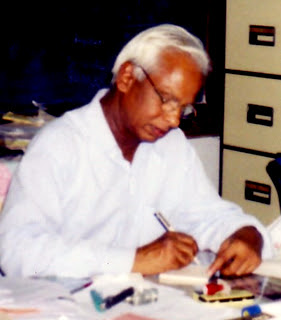
Prof. B. N. Patnaik’s article is a thoughtful and original
study of a small yet significant episode in Sarala Mahabharata. The article
focuses on the story of Kiratasena, a forest king who does not appear in
Vyasa’s Mahabharata. Professor Patnaik argues that this episode is Sarala Das’s
own creative innovation. At first, the story may seem unnecessary because it
does not directly affect the main movement of the Kurukshetra war. Yet, by the
end of the article, Professor Patnaik shows that the episode holds deep
religious and poetic significance within Sarala’s larger vision of the
Mahabharata as a “Bishnu Purana”.
1. The
central argument of the article
Prof. Patnaik’s main argument is clear. The
Kiratasena episode is absent from Vyasa’s Mahabharata. It is Sarala Das’s own
addition. This is important because it shows that Sarala was not merely
translating or retelling Vyasa. He was interpreting the epic in his own creative
and devotional way.
Professor Patnaik first admits that the
Kiratasena episode does not advance the main plot. The war would have unfolded
the same way even without Kiratasena. Neither the Pandavas nor the Kauravas
depend on him. His entry and exit do not alter the course of the war. In that
sense, the episode appears to be an interruption.
But Professor Patnaik does not stop there. He
poses a deeper question. If the episode does not serve the war’s outer
narrative, why did Sarala include it? His answer is that Sarala’s Mahabharata
is not only about the Kuru family but also about the glory of Krishna.
Therefore, any episode that showcases Krishna’s grace becomes meaningful.
This is the article's strength. Professor
Patnaik shifts from a narrative reading to a theological one. He shows that the
story is weak as a plot device but strong as a spiritual episode.
2.
Kiratasena as a marginal but powerful figure
Kiratasena is a king among the forest
dwellers. He comes to Kurukshetra with his son Jara, eager to fight in the war
and gain glory. Secretly, he harbours an old desire for revenge because in a
previous birth he was Bali, whom Rama had killed.
This makes Kiratasena a compelling character.
He is not a simple warrior. He carries memories of an earlier yuga. His story
connects the worlds of the Ramayana and the Mahabharata. Through him, Sarala
builds a bridge between Rama and Krishna.
Kiratasena is rejected by both Duryodhana and
Yudhisthira. Duryodhana rejects him because he distrusts forest dwellers and
finds Kiratasena boastful. Yudhisthira also rejects him, viewing the war as a
battle among kshatriyas and brothers. Both sides treat him as an outsider.
This rejection is significant. It reveals the
social world of the epic. Kiratasena is powerful, yet he is not accepted. He
has divine arrows, but he lacks social legitimacy. He is brave, yet caste and
social location stand in his way.
Professor Patnaik does not develop the caste
angle strongly, though it is present in the article. Ph.D.-level research can
extend this point. Kiratasena’s rejection shows that power in the epic world is
controlled by caste, lineage, and social recognition. The forest king may
possess extraordinary strength, but he remains outside the political order of
the war.
3. From
revenge to devotion
One of the most beautiful moments in the story
is Kiratasena’s sudden transformation. He arrives with a hidden desire to
avenge Krishna, whom he believes killed him in the form of Rama. But when he
sees Krishna, he is filled with devotion.
Professor Patnaik rightly observes that Sarala
does not explain this change in detail. The article suggests that Krishna's
darshan purified Kiratasena, which is a significant insight.
In Sarala’s devotional world, Krishna’s
presence alone transforms the human being. Revenge and ego disappear. The
desire to fight becomes secondary. What remains is surrender.
This is where Kiratasena’s story becomes
spiritually powerful. He does not win glory on the battlefield. He attains
something higher than military victory. He offers his head to Krishna and, in
return, receives moksha.
4. The
meaning of dana in the episode
The most significant act in the Kiratasena
story is not war but the gift. Kiratasena offers his head to Krishna as dana.
This is a striking image. The warrior who came to fight becomes a devotee who
gives himself completely to the divine.
This act redefines heroism. In ordinary epic
terms, heroism means defeating enemies. In Sarala’s spiritual vision, it means
surrendering the ego to Krishna.
Kiratasena’s head is severed by Krishna’s
Sudarshana Chakra. Professor Patnaik explains that this is not merely a
killing. It is an act of grace. Because Krishna uses the Sudarshana Chakra,
Kiratasena attains liberation. He is not destroyed. He is redeemed.
This is a crucial theological point. In
Sarala’s imagination, Krishna is not merely a strategist in the war. He is
Narayana himself, the giver of moksha. Therefore, death at his hands is a form
of spiritual release.
5.
Kiratasena and moksha
Professor Patnaik’s discussion of moksha is
among the article’s finest parts. Kiratasena’s severed head remains alive on
Krishna’s chariot. Krishna grants him the wish to witness the war and, more
than that, an eternal place on the chariot.
This means Kiratasena is freed from ordinary
death and rebirth and remains connected to Krishna forever. Professor Patnaik
suggests that Sarala understands moksha as eternal nearness to Narayana.
This is a simple yet profound idea. Here,
moksha is not an abstract philosophy. It is not presented as a dry metaphysical
state. Instead, it is shown as a living closeness to God. Kiratasena’s
liberation lies in being placed on Krishna’s chariot and in being remembered by
divine grace.
6.
Comparison with Belalasena
Prof. Patnaik compares Kiratasena with
Belalasena, another character created by Sarala. This comparison is useful
because both characters come to fight in the war, are prevented from fighting,
offer their heads to Krishna, wish to witness the war, and receive Krishna’s
grace.
But Professor Patnaik draws a major
distinction. Belalasena serves a clear narrative purpose. After the war, his
severed head tells the Pandavas the truth. He reveals that no warrior won the
war by personal power. It was Krishna’s divine discus that moved across the
battlefield, destroying warriors. This revelation humbles the Pandavas and
exposes the illusion of human pride.
Kiratasena, however, does not serve such a
narrative function. He sees the war but does not tell anyone. No one asks him.
His witnessing remains private.
This comparison helps Professor Patnaik make
his point. If we judge Kiratasena solely on narrative grounds, the episode
seems unnecessary. But if we judge it by Sarala’s devotional purpose, it
becomes meaningful.
7. The real
purpose of the Kiratasena episode
The episode’s true purpose is to reveal
Krishna’s grace. This is Professor Patnaik’s final and strongest argument.
Sarala’s Mahabharata is not only a story of
family conflict, kingdom, war, and revenge. It is a sacred retelling that
celebrates Krishna’s leela. Sarala repeatedly calls his work “Bishnu Purana.” Professor
Patnaik explains that Sarala does not refer to the Sanskrit Vishnu Purana as a
specific text. He uses the phrase to describe his own work as a puranic account
of Vishnu’s glory.
This changes how we read the entire text. The
Kuru story becomes the narrative’s outer body, while Krishna’s leela becomes
its inner soul.
Therefore, Kiratasena is not superfluous. His
story may be unnecessary to the war plot, but it is essential to Sarala’s
broader religious imagination. It shows that Krishna’s grace can reach even a
forest king who enters the narrative from the margins.
8.
Originality of Prof. Patnaik’s article
The originality of Professor Patnaik’s article
lies in his choice of subject and his method of reading. He takes a small,
neglected episode and shows its significance. He does not dismiss it as a loose
addition. He patiently asks why Sarala might have included it.
His approach is balanced. He first
acknowledges the problem. The Kiratasena episode does look like an intrusion.
He then shifts the ground of interpretation. He argues that the episode becomes
meaningful when we understand Sarala’s Mahabharata as a Krishna-centred text.
This is a strong scholarly move. It shows that
a retelling should not always be judged by the source text’s standards.
Sarala’s work has its own logic, theology, and poetic vision.
9. A
critical observation
One limitation of the article is that it does
not fully explore the social and caste significance of Kiratasena. The story
clearly shows that Kiratasena is rejected for being a forest dweller and deemed
low-born. This could have prompted a deeper discussion of caste, exclusion, and
marginality in Sarala’s epic world.
Kiratasena is powerful yet unwanted. He is
capable yet distrusted. He is spiritually worthy yet socially rejected. This
tension warrants greater attention.
A Dalit or subaltern reading could pose an
important question. Why does the forest king receive recognition only through
divine grace, not through social acceptance? The human world rejects him,
whereas Krishna redeems him. This contrast helps us understand Sarala’s complex
vision of society and spirituality.
Yet this limitation does not weaken the
article. Rather, it opens avenues for further research.
10.
Conclusion
Prof. Patnaik’s article is a valuable
contribution to the study of the Sarala Mahabharata. It shows that Sarala Das
was not a passive reteller of Vyasa. He was a creative poet, interpreter, and
theologian. Through the story of Kiratasena, Sarala expands the epic world and
gives a marginal figure the space to attain liberation through Krishna’s grace.
The article teaches us that every addition to
a regional epic should be read carefully. What seems unnecessary at the plot
level may become deeply meaningful at the level of philosophy, devotion, and
cultural imagination.
Kiratasena comes to Kurukshetra seeking glory
and revenge. He leaves the ordinary human world for moksha. This movement from
revenge to surrender, from exclusion to grace, and from death to eternal
nearness to Krishna is the heart of the episode. Prof. Patnaik’s article helps
us see this heart clearly and sympathetically.
Dr. Babuli Naik

No comments:
Post a Comment