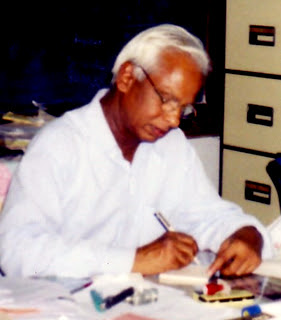
Professor B. N. Patnaik’s blog “Bhima and
Krishna: A Relook” offers a brief yet intellectually suggestive reading of
Sarala Mahābhārata. On the surface, the blog compares Bhīma and Krishna on a
single shared trait: their inability to be “contented.” But the essay’s deeper
force lies elsewhere. Professor Patnaik is not simply comparing two characters.
He uses Bhīma as a foil to illuminate Krishna’s theological, ethical, and
narrative distinctiveness in Sarala Das’s Odia retelling of the Mahābhārata.
The blog, therefore, becomes a compact meditation on desire, violence, divine
excess, avatāra, and the difference between Vyasa’s Sanskrit epic and
Sarala’s Odia epic imagination.
1. The
Central Argument
The blog’s central argument is that Bhīma and
Krishna share insatiability, yet their insatiability belongs to two entirely
different orders of being. Bhīma’s lack of contentment is bodily, instinctive,
and sensuous. By contrast, Krishna’s lack of contentment is metaphysical and
theological. Bhīma is never satisfied with food, fight, sleep, or sex. Krishna
cannot be satisfied with gifts, honour, devotion, or knowledge. The comparison
is therefore deliberately paradoxical. Patnaik begins with similarity but ends
with radical difference.
This is the blog’s intellectual strength. It
does not reduce Bhīma and Krishna to flat opposites. Instead, it creates a
critical bridge between them through the concept of “atripti,” or
non-satisfaction. Once that bridge is in place, the essay shows that the same
term carries different meanings when applied to a human hero and to the divine
avatāra. For Bhīma, insatiability is appetite. For Krishna, it is
transcendence.
2. Bhīma as
the Figure of Embodied Excess
Professor Patnaik’s Bhīma is a being of
immense physicality. He is “simple and guileless,” yet also violent, impulsive,
sensuous, and dangerous. The blog repeatedly emphasises Bhīma’s bodily
immediacy. He eats with intensity, fights brutally, loves possessively, and
acts before reflecting. He belongs to the world of force rather than subtlety.
This reading is persuasive because Bhīma has a
complex role in the Mahābhārata tradition. He is crucial to the victory of
dharma, yet he is not always morally refined. He defends Draupadi, defeats
villains, and shows loyalty to the Pāṇḍavas, but he also transgresses the
bounds of civilised conduct. Patnaik effectively highlights this ambiguity.
Bhīma is more than a hero; he is a challenging figure. His energetic pursuit of
justice often manifests as violence.
Professor Patnaik's examples are compelling:
Kīchaka's death, Duḥśāsana's killing, Bhīma's failure in Drona’s archery test,
his anger towards Kunti, and the death of Belālasena’s living head all portray
Bhīma as someone whose strength outweighs his reflective thinking. His actions
are driven by instinct rather than careful judgment. His main ethical struggle
isn't cowardice or disloyalty, but an overabundance of force.
At a deeper level, Bhīma becomes a study in
the instability of heroic masculinity. He is virile, powerful, and fearless,
yet morally vulnerable because he cannot control himself. His violence is not
merely external. It is constitutive of his personality. Patnaik’s repeated
emphasis on hunger, blood, mace, food, sleep, and sexual craving gives Bhīma a
strongly corporeal identity. He is almost elemental, fittingly the son of
Pavana, the Wind. Like the wind, he is forceful, restless, and difficult to
contain.
3. The
Question of Violence
One of the most interesting aspects of the
blog is its treatment of Bhīma’s violence. Professor Patnaik does not
romanticise it. He draws a clear distinction between necessary and excessive
violence. For instance, Bhīma’s oath to kill Duḥśāsana may be understood within
the moral economy of revenge following Draupadi’s humiliation, but the
brutality with which he carries it out goes beyond the demands of the oath.
This distinction is important for Mahābhārata
studies because the epic often asks us to consider the difference between
justice and revenge, dharma and cruelty, and punishment and sadistic pleasure.
Bhīma stands precisely at this troubled border. He fights on the Pāṇḍavas’
side, yet his methods often disturb the moral comfort of that side. In this
sense, Patnaik’s reading prevents a simplistic glorification of Bhīma as a
hero.
However, one may also critically extend
Patnaik’s argument. Bhīma’s violence should not be reduced to a mere character
flaw. It is also structurally produced by the world of the Mahābhārata. The
epic world repeatedly fails Draupadi, justice, and the possibility of a
peaceful settlement. In such a world, Bhīma becomes the terrible instrument of
deferred justice. His violence is excessive, but the social and political order
that creates the need for such violence is equally excessive in its injustice.
A fuller reading may therefore ask whether Bhīma is simply “dusta” or whether
he is the epic’s uncomfortable answer to a broken moral order.
4. Bhīma
and the Limits of Dharma
Professor Patnaik notes that both Kunti and
Yudhiṣṭhira call Bhīma “dusta,” an important observation. Yudhiṣṭhira embodies
dharma, restraint, deliberation, and moral anxiety, whereas Bhīma embodies
action, retaliation, appetite, and embodied justice. The tension between the
two brothers is therefore not merely temperamental but philosophical.
Yudhiṣṭhira’s dharma is reflective yet often
ineffective. Bhīma’s action is effective yet morally troubling. As Patnaik
understands it, Sarala’s narrative preserves this tension rather than resolving
it. Bhīma is needed, but he cannot be fully approved. He is indispensable to
the restoration of order, yet he cannot serve as a model of order.
This gives the blog a subtle ethical
dimension. Patnaik is not merely condemning Bhīma. He shows that Bhīma belongs
to a sphere where dharma must employ forces that are not fully dharmic. This is
one of the enduring tragic complexities of the Mahābhārata tradition.
5. Draupadi
and the Question of Sexuality
Professor Patnaik’s discussion of Bhīma’s
sexuality is bold and deserves attention. He argues that Bhīma’s sexual conduct
is “above reproach” in one sense, as he never casts a lustful eye on any woman
who is not his wife. Yet his craving for Draupadi is described as excessive and
difficult for her to bear. This raises an important ethical complication.
The blog does not sentimentalise Bhīma’s love
for Draupadi. In many popular readings, Bhīma is often portrayed as Draupadi’s
most devoted husband, the one who responds most fiercely to her humiliation.
Patnaik does not reject that image, but he complicates it by introducing the
problem of desire within marriage. His point is significant: the legitimacy of
a marital relationship does not automatically resolve the ethical questions of
consent, comfort, and reciprocity.
This is one area where the blog opens the
possibility of a feminist reading, though it does not develop it fully.
Draupadi appears not merely as a shared wife but as a woman who bears the
burden of male desire. The moral code worked out by the husbands becomes
necessary because Bhīma’s desire is too intense. A PhD-level extension of
Patnaik’s argument would ask how Sarala Das represents Draupadi’s agency,
discomfort, speech, and negotiation within a polyandrous household. Such a
reading could connect the blog’s insight to broader questions of gender, the
body, marriage, and power in vernacular Mahābhārata traditions.
6. Krishna
as the Figure of Divine Inexhaustibility
The second half of the blog turns to Krishna.
Here, Professor Patnaik’s argument becomes more theological. Krishna is
described through Sakuni’s warning to Duryodhana: he cannot be satisfied by
gifts, honour, devotion, or knowledge. The phrase “danena atriputi je manena
atriputi / bhagate atriputi je jnanena atriputi” serves as the interpretive
key.
This is a remarkable shift. In Bhīma, lack of
contentment signals appetite. In Krishna, it signals the impossibility of
confining the divine within human transactions. One cannot “satisfy” Krishna
because he is not a needy recipient. He is not dependent on human offerings.
Gifts, honour, devotion, and knowledge do not complete him. The divine cannot
be placed under obligation by ritual or moral economy.
Professor Patnaik’s reading of the Vāmana-Bali
episode within the Krishna-Duryodhana negotiation is especially powerful.
Sakuni reads Vāmana as a dangerous figure of divine dispossession. Bhishma
corrects him by completing the story, reminding Duryodhana that Bali was not
merely deprived but also blessed. This contrast between Sakuni’s partial
narrative and Bhishma’s fuller account is crucial. The divine act may appear as
loss at one level yet become grace at another. The meaning of divine
intervention depends on the completeness of vision.
7. Sakuni’s
Narrative and the Politics of Partial Truth
One of the blog’s strongest critical strengths
lies in its treatment of Sakuni. Sakuni is not portrayed as a simple liar. He
tells a story that is not entirely false, but only partially so. His version of
the Vāmana-Bali narrative is selective. He stops at dispossession and omits the
moment of divine grace.
This is a profound insight into the politics
of narration. Falsehood does not always operate by inventing facts. It often
operates by withholding completion. Sakuni’s narrative becomes a political use
of myth. He weaponises a sacred story to strengthen Duryodhana’s refusal. In
this sense, Professor Patnaik’s blog quietly raises a major hermeneutic issue:
who tells a story, where they stop, and what they omit can change the story's
ethical meaning.
This point remains relevant today. Many
political and cultural narratives rely on partial truths, selectively citing
history, scripture, or tradition. Sakuni’s method is therefore not merely epic
cunning. It is a general model of ideological narration.
8. Krishna,
Leela, and the Limits of Human Transaction
Professor Patnaik’s conclusion is deeply
philosophical. He writes that Krishna is neither pleased when one worships him
nor displeased when one does not. He is neither pleased by praise nor
displeased by abuse. What then remains? Perhaps only to witness his līlā.
This is one of the most suggestive moments in
the blog. It moves Krishna beyond the economy of reward and punishment. Human
beings often approach the divine through exchange: I worship, so bless me; I
offer, so protect me; I praise, so be pleased with me. Patnaik’s Krishna
transcends this transactional theology. Divine līlā cannot be controlled
by devotion, ritual, knowledge, or honour.
This reading brings Sarala Mahābhārata close
to a bhakti-metaphysical vision in which the divine is intimate yet not
manageable, present yet not possessable, and responsive yet not reducible to
human expectations. Krishna is not merely a character in the story. He is the
hidden centre of meaning.
9. Vyasa
and Sarala: Dharma and Moksha
The note at the end of the blog is highly
important. Professor Patnaik states that Vyasa’s Mahābhārata is about Nara, the
human, whereas Sarala’s Mahābhārata is about Nārāyaṇa, the Supreme God. Vyasa’s
text focuses on dharma, whereas Sarala’s focuses primarily on moksha and
secondarily on dharma.
This is perhaps the most thesis-like statement
in the entire blog. It offers a broad comparative framework for distinguishing
the Sanskrit epic from its Odia retelling. In this formulation, Sarala Das does
not merely translate Vyasa. He reorients the epic. The movement is from ethical
crisis to spiritual release, from human action to divine play, and from dharma
as a social-moral order to moksha as ultimate liberation.
This is a valuable insight for vernacular epic
studies. It recognises Sarala Mahābhārata as a creative, interpretive, and
theological re-composition rather than a derivative regional version. Sarala’s
originality lies not only in language or local colour but also in philosophical
orientation. His Mahābhārata is not merely Odia in idiom. It is distinct in its
metaphysical emphasis.
10.
Critical Observations on Professor B.N. Patnaik’s Reading
While the blog is rich, some areas invite
further inquiry.
First, Bhīma’s characterisation may seem
slightly overdetermined by violence and appetite. While these are undoubtedly
central to Sarala’s Bhīma, as the writer reads him, Bhīma’s tenderness,
loyalty, and emotional vulnerability also merit exploration. His love for
Draupadi, his devotion to his brothers, and his role as protector complicate
any purely violent reading.
Second, the blog accords Krishna significant
interpretive privilege, while Bhīma is largely cast as a foil. Professor
Patnaik himself acknowledges this when he says that Sarala’s real concern is
Krishna, not Bhīma. Yet one may ask whether Bhīma deserves a more independent
reading. If Krishna represents divine transcendence, Bhīma may embody the
tragic necessity of embodied action in a violent world.
Third, the claim that Vyasa’s Mahābhārata is
about dharma while Sarala’s is about moksha is illuminating,
though it may need further nuance. Vyasa’s Mahābhārata also contains powerful moksha-oriented
passages, especially in the Śānti Parva and Anuśāsana Parva. Similarly,
Sarala’s text cannot be entirely separated from dharma. Therefore, the
distinction is useful as an interpretive emphasis, but perhaps not as an
absolute division.
Fourth, the blog’s theological conclusion that
Krishna is neither pleased nor displeased by human acts raises a fascinating
question: what, then, is the role of bhakti? If devotion cannot please Krishna
in a transactional sense, does it still transform the devotee? Perhaps the
purpose of bhakti is not to change God’s attitude but to transform the human
self. This is a direction the blog hints at but does not fully develop.
11.
Original Contribution of the Blog
The originality of Patnaik’s blog lies in its
ability to draw a major philosophical insight from a concise character
comparison. The blog does not merely say that Bhīma is physical and Krishna is
divine. It shows that the same trait, non-contentment, operates at two levels:
the bodily and the metaphysical. This yields a layered reading of Sarala
Mahābhārata.
Its second contribution is to foreground the
theological distinctiveness of Sarala’s epic. Sarala’s Krishna is not merely a
strategist, diplomat, or divine helper. He is the avatāra whose presence
transforms the epic’s meaning. In Patnaik’s reading, the story of the Pāṇḍavas
and Kauravas becomes a field for understanding divine intervention.
Its third contribution is hermeneutic. Through
the competing versions of the Vāmana-Bali story by Sakuni and Bhishma, the blog
shows how narrative can mislead when incomplete. This is a subtle yet powerful
insight into epic storytelling.
Conclusion
Professor B. N. Patnaik’s “Bhima and Krishna:
A Relook” is a short essay with a wide interpretive reach. It begins with a
simple observation that Bhīma and Krishna are both “not contented,” but
gradually develops this into a philosophical distinction between bodily
appetite and divine inexhaustibility. Bhīma embodies force, hunger, rage, and
sensuous embodiment. Krishna embodies the inscrutable fullness of the avatāra,
who cannot be satisfied because he lacks nothing.
The blog’s deeper achievement lies in its
reading of Sarala Mahābhārata as a text centred on Nārāyaṇa and moksha. In this
view, Sarala Das does not merely retell Vyasa’s epic. He reimagines it as a
theological and liberative narrative. Professor Patnaik’s essay is therefore
valuable not only as a character study of Bhīma and Krishna, but also as a
critical entry point into the distinctiveness of the Odia Mahābhārata
tradition.
A fuller academic paper could emerge from this
blog by developing three lines of inquiry: Bhīma as embodied excess, Krishna
as non-transactional divinity, and Sarala Mahābhārata as a vernacular
reorientation of the epic from dharma to moksha. In that sense, the blog is
not a finished scholarly argument. It is also a seed for a larger research
project.
Dr. Babuli Naik
Associate Professor
Department of English
Motilal Nehru College
University of Delhi
Email: bnaik@mln.du.ac.in